Beginner guide: how to shape sourdough bread boule
Beginner guide: how to shape sourdough bread boule. Homemade sourdough final shaping is one of the most important basics to master for perfect loaves. It is a simple process, without the need for any special tools. You can either shape it into a sourdough batard (oblong loaves or oval shape) or a boule which is a round loaf of crunchy bread.
Equipment
- bench scraper
Ingredients
- 1,000 grams white bread flour
- 650 grams warm filtered water
- 200 grams leavened sourdough starter
- 20 grams salt
Instructions
- After your final proof or the bulk fermentation and once your bread has gone through a few stretches and folds, flip out your bread on a clean dry work surface to do the final shape on your dough before either baking or cold proofing. Do not dust the countertop with too much flour. The reason for that is when you are shaping your dough, you need the dough to adhere to the countertop to help you create surface tension. If the dough is sticky because of a high hydration dough, dust the countertop with 1 tablespoon of flour and use a dough scraper to help with the sticky dough.
- Let the dough bench rest for 10 minutes (dough rest on the countertop). This will allow the gluten in the dough to relax, so it will be easier to shape. Be gentle here to not pop or disturb any of those precious bubbles it has already formed.
- Carefully pull the dough from all sides to stretch it out just a few inches. Fold one side of the dough onto itself towards the middle. Then fold the other side.

- Once the two sides are folded, roll the dough into a ball. then seal the ends. Tuck the ends underneath the dough to form a ball.

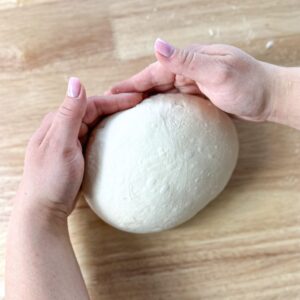
- After the sourdough is formed into a ball, cup both hands on the outside of the loaf and push the dough towards you just an inch or so. This creates surface tension on top of the loaf to get a good oven spring by creating a good gluten structure.

- Turn the loaf to the right just a quarter then cup your hands against the loaf and push it towards yourself just an inch, keep doing this process till you have gone all around the circle. This aligns all the gluten strands to be equal all around. You will see the top of the dough start to tighten. The dough should be keeping its shape now.

- Twist the dough in a circular motion on the table to create tension on the bottom of it. This helps to close up any open holes. Flip the dough with the seam side up into a proofing basket or a round banneton. (dust the banneton with flour to prevent it from sticking, you can also use rice flour)
- Pinch closed any open holes that might be on the seam side up. Cover with plastic wrap or a shower cap and place in the fridge for a cold fermentation or let it rise at room temperature, depending on what recipe you are using!

IF THE BOULE STILL ISN’T KEEPING ITS SHAPE
- If your dough is excessively weak and is too relaxed after shaping, you can add a little structure to the dough by pinching the top. After you transfer your dough to the proofing basket grab the dough’s very outside edge and fold it over to the middle. To create a little package, do this at four sides, where each “flap” is opposite another one.

- After the four-folds, you’ll have an even tighter round. This last-minute pinching will create quite a bit of tension in the dough, adding strength to a boule that might otherwise spread significantly in the oven while baking.