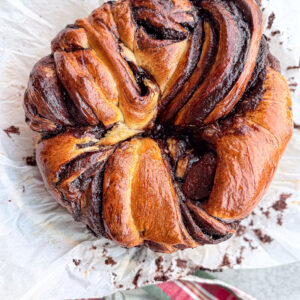
sourdough chocolate babka
The softest sourdough chocolate babka with rich chocolate swirls — made with wild yeast, no commercial yeast needed.
Equipment
- stand mixer
- Food scale
- mixing bowl
- Parchment paper
- baking vessel (baking tray or loaf pan)
Ingredients
Sweet Stiff Starter (Sweet Levain)
- 28 g active starter
- 55 g flour
- 28 g water
- 1 tsp honey
Babka Dough
- 340 g bread flour (or all-purpose flour)
- 120 g warm whole milk
- 2 large eggs + 1 egg yolk
- 100 g sweet stiff starter (peaked)
- 50 g sugar
- 80 g unsalted butter, softened
- 6 g salt
- 1 tsp vanilla
- 30 g Greek yogurt
Chocolate Filling
- 30 g cocoa powder
- 60 g sugar
- 50 g melted butter
- 1 tbl milk
- 1 cup chocolate chips or chopped chocolate
Egg Wash
- 1 egg
- 1 tsp milk
Simple Syrup
- 2 tbl sugar
- 2 tbl boiling water
Instructions
mix the sweet stiff starter
- Start with mixing the sweet stiff starer, i usually do this the night before!

Mix the Dough
- In the bowl of your stand mixer, whisk together the warm milk, eggs, sweet stiff starter, Greek yogurt, and sugar. Make sure to really break up that starter so everything blends smoothly.Pop on the dough hook and sprinkle in the bread flour and salt. Let it mix on low speed just until the dough starts coming together and looks a little shaggy — that’s exactly what you want at this stage.Add the Butter SlowlyWith the stand mixer on speed 3, add the softened butter 1 tablespoon at a time.This is a slow process — expect 20–30 minutes for the dough to become smooth, elastic, and strong.If it gets too warm, turn off the mixer and let it rest 10–15 minutes.The dough is ready when:it stretches thin without tearingthe top of the dough looks smooth and glossyit passes the windowpane test

Coil Folds
- Transfer dough to a clean bowl.After 1 hour, perform a coil fold to strengthen the gluten.Repeat 2–3 times, every 30 minutes
Bulk Fermentation
- Let the dough relax for 4–6 hours, give or take, depending on your room temperature. It shouldn’t double in size — a light, 30% puff is all you’re aiming for here.

Overnight Rest
- Cover dough with plastic wrap and refrigerate 12 hours.This makes it easier to roll and improves flavor.
Prepare Filling
- Make the chocolate filling the next day and let it cool completely so it spreads smoothly.Warm in a small saucepan over low heat. Stir until smooth and the sugar dissolves. Let cool.

Roll the Dough
- On a floured work surface, roll the dough into a thin rectangle using a rolling pin.Spread the filling all the way to the edges using a spatula — no border needed.

Roll + Slice & Twist + Braid
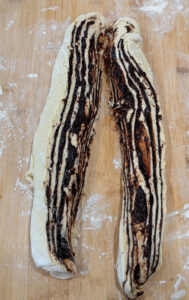
- Starting from the long side, roll the dough into a tight log (like cinnamon rolls).Using a sharp knife or bench scraper, slice the log half lengthwise to expose the chocolate layers.After you slice the log in half lengthwise, you’ll have two long chocolatey strands. Gently lift each piece and give it a few twists so the cut sides are facing up and you can really see those swirly layers — think of them like two chocolate ribbons.Once they’re lightly twisted, lay them side by side and braid/twist the two strands together to form your babka loaf.You can leave it as a single loaf or connect the ends to form a wreath.Transfer the shaped babka onto parchment paper or into a loaf pan if your making one loaf. spring form, or onto a baking tray.
Final Proof
- Let it rise in a warm temperature area for about 2 hours until puffy.
Bake the Babka
- Egg WashBrush with egg wash using a pastry brush.Bake at 350°F for 40 minutes, or until golden brown or the Internal temperature reaches 190°FCool on a wire rack.

Brush with Simple Syrup
- In a small bowl, combine the sugar and boiling water, stirring until the sugar dissolves. Right out of the oven, brush the babka with your sugar syrup.This keeps the crust shiny, soft, and beautifully moist.

Notes
Frequently Asked Questions
Why does my dough look greasy or broken while mixing?
Don’t panic — this is totally normal with enriched doughs. When you first add the softened butter, the dough will look messy, slick, and like it’s never going to come together. Just keep your mixer running. As the gluten builds, everything will eventually smooth out and turn into a beautiful, elastic dough. Patience is the secret here!How long does it take for the dough to come together?
A babka dough can take 20–30 minutes in a KitchenAid on medium–low speed. That’s a long time, but completely expected. If it’s been 8 minutes and still looks sloppy, don’t add flour — let the mixer do the work. You’re looking for smoothness and elasticity, not dryness.My dough feels very soft. Is that okay?
Yes! Babka dough should be soft, supple, and a little sticky. This is an enriched brioche-style dough made with eggs, butter, milk, and yogurt — all things that make it tender and silky. A soft dough means a soft crumb later.How do I know the dough is ready?
It’s ready when it:- looks smooth on the surface
- stretches thin without tearing (windowpane test)
- pulls cleanly from the sides of the bowl
- feels elastic instead of mushy