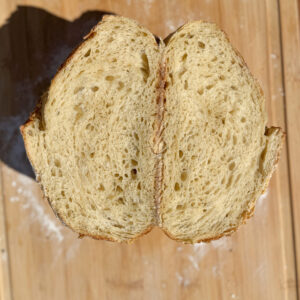
Sourdough Croissant Loaf
This Sourdough Croissant Loaf is my favorite way to bring bakery-style flavor into my own kitchen. It’s buttery, crisp on the outside, and soft with light layers inside. It’s perfect with coffee or a bit of jam.
Equipment
- Large mixing bowl- I love these Mason cash bowls!
- food grater- to grate the frozen butter
- Dutch oven– this bread oven is one of the best Dutch ovens I’ve used so far! Bakes our bread to perfection
Ingredients
Sweet Levain
- 25 g active sourdough starter
- 50 g water
- 50 g bread flour
Main Dough
- 120 grams active starter from the levain
- 325 grams water
- 500 grams bread flour
- 10 grams salt
- 113 grams butter 1 stick, frozen and grated
Instructions
- Prepare the levain by mixing 25g starter, 50g water, and 50g bread flour in a small jar. Cover and let it ferment at room temperature for 4–6 hours, or until bubbly and tripled in size. Measure out 120 grams for the dough.
- In a large mixing bowl, combine the 120 grams active starter with the water and whisk until dissolved. Add the bread flour and salt and mix until no dry flour remains. Cover and let the dough rest for 1 hour.
- Keep the dough in a cool area (68–72°F if possible) and perform 3 sets of stretch and folds, one hour apart. Incorporate half of the grated butter during the first stretch and fold and the remaining butter during the second, gently folding it into the dough. After the final stretch and fold, let the dough rest for another hour.
- Shape the dough into a loose boule and let it rest for 30 minutes. Perform a final letter fold and shape into a tight boule. Transfer to a lightly floured proofing basket, cover, and refrigerate for an overnight cold ferment of 8–16 hours.
- Preheat the oven to 475°F with a Dutch oven inside. Carefully invert the chilled dough onto parchment paper or a bread sling, score the top, and transfer it into the hot Dutch oven. Bake covered for 40 minutes, then remove the lid and bake for an additional 5–10 minutes until deeply golden.
- Transfer the loaf to a wire rack and allow it to cool completely before slicing and serving.
Notes
- Use a bubbly, active starter. A strong starter is essential for getting a beautiful rise and light, airy crumb.
- Keep the dough cool during butter incorporation. Cooler temperatures help the grated butter stay in small pieces instead of melting into the dough, creating delicate croissant-like layers.
- Freeze and grate the butter. Grated frozen butter distributes much more evenly throughout the dough and is easier to fold in.
- Don't rush the mixing. The dough may feel softer than a traditional sourdough because of the butter, but it should still hold its shape.
- Be gentle during the stretch and folds. Folding carefully preserves the butter layers and helps create the flaky texture.
- Allow for an overnight cold ferment. This develops a deeper sourdough flavor while improving the loaf's structure and texture.
- Build good surface tension when shaping. A tight boule encourages better oven spring and a taller finished loaf.
- Always preheat the Dutch oven thoroughly. An extra 30 minutes of preheating creates the steam needed for an excellent crust.
- Use parchment paper or a bread sling. It makes transferring the dough easier and catches any butter that may escape during baking.
- Score the loaf deeply. Proper scoring gives the dough room to expand instead of cracking unpredictably.
- Cool completely before slicing. Cutting too early can compress the crumb and make the interior gummy.
- Don't worry if your stand mixer takes longer. Enriched doughs often require more mixing time to fully develop the gluten.
- Resist adding extra flour. The dough should feel soft and slightly tacky rather than stiff or dry.
- For extra richness, use European-style butter. Its higher butterfat content produces an even more luxurious crumb.
- Try fun inclusions. Parmesan, cheddar, gruyère, rosemary, thyme, garlic powder, cinnamon sugar, cranberries, raisins, walnuts, or pecans all work beautifully.
- If the bottom browns too much, place a baking sheet on the rack below the Dutch oven to diffuse the heat.
- Use parchment as a heat buffer. It provides a little extra insulation and can help prevent an overly dark bottom crust.
- Freeze leftovers for longer storage. Once completely cooled, wrap tightly and freeze for up to 3 months, then reheat at 325°F for 10–15 minutes before serving.